Showing posts with label Botany. Show all posts

Friday, 12 May 2023

To see a world in a grain of sand.....

.... or to see an entire little ecosystem, all alone, with no human interference:

Isn't that great?

Spotted last week, whilst on holiday - yes, shock horror, I do actually go on holiday from time to time! 

This is the crotch of a large old Ash tree, and this was about at head height: the crotch formed a little pocket where debris, and water, would collect, and in a while, plants started growing.

I could see grass, a fern or two, some cow parsley, a wild geranium, and a couple of sycamore seedlings, along with what could turn out to be a dandelion - hard to say, with only one leaf to look at - and, of course, moss. 

It rather reminded me of those gardens-in-a-bottle that you sometime find: quite self-contained, do you know the sort of thing? I had one, for several years: some of the plants grew too large for the bottle, and although I was careful not to overwater it, it eventually succumbed to mould. 

This one, however, will probably flourish, for some time, at least, because it's open unto the trees and to the sky (second poetry reference in one article, I should go away on holiday more often!) so mould won't be a problem: although I think the cow parsley and the Sycamore might turn out to be too large... and of course, it won't have any human interference, as it is quite literally in the middle of nowhere: so it won't get weeded, or weed-killed.

I do rather like the idea that no-one planted it, no-one tends it: it started of its own accord, and will continue to grow until, well, there's no reason for it to ever stop growing, really: even if the tree were to die and eventually fall over, the rotting wood would just be more nutrients for this tiny little garden.

If some of the occupants become too big to be supported, they'll die: and more weed seeds will drift in from above, to take their place.

Rather lovely, I thought.


Did you enjoy this article? Did you find it useful? Would you like me to answer your own, personal, gardening question? Become a Patron - just click here - and support me! Or use the Donate button for a one-off donation. If just 10% of my visitors gave me a pound a month, I'd be able to spend a lot more time answering all the questions!!

Monday, 27 February 2023

Snowdrops - time to enjoy them.

I'm always writing about Snowdrops, among other things - and occasionally, it's nice to just stop and admire them.


There! 

Isn't that lovely?

Particularly nice, I thought, with the pale winter sun making bold shadows of the trees.

These were all Galanthus nivalis, which is what you might call "common snowdrop", as it's the one you are most likely to find while out walking, ie not in someone's cultivated garden.

There are only three species of Galanthus which you would encounter in the wild, as it were: these ones, G. nivalis (which always makes me think of Nivea), G. plicata, and G. elwesii.

If you'd like to know the difference, you can't do much better than to download my Field Guide on the subject:


 ...and if you have Kindle Unlimited, it's free!

Free!

All that work, for free!

(and if you don't have Kindle Unlimited, it's only a couple of quid, go on, buy it, go on, go on!)

I love the way that we can only have Snowdrops now, in late winter: unlike buying out-of-season fruit and veg all year round in the supermarket, we can only admire these delicate beauties on their own terms.

And it always lifts my spirits, because whenever you see a drift of "wild" snowdrops, out there in woodland, or alongside footpaths, or on verges: always, there is the thought that someone, some day, planted the original clump, and then left them there to multiply, so that everyone walking past can enjoy them.

Community spirit, at its best!


Did you enjoy this article? Did you find it useful? Would you like me to answer your own, personal, gardening question? Become a Patron - just click here - and support me! Or use the Donate button for a one-off donation. If just 10% of my visitors gave me a pound a month, I'd be able to spend a lot more time answering all the questions!!

Sunday, 25 December 2022

Don't eat Yellow Snow....

Are we having a white Christmas?

Do we EVER have a white Christmas?

Well, no. We don't.

But here's a seasonal article anyway, for those of you who are so bored on Christmas Day that you have nothing better to do than come here and see if I have posted anything new. You are so sad! But who cares, it's Christmas! And if you'd rather be quietly reading, than arguing about who forget the sprouts, how many glasses of sherry Aunt Bertha has drunk, or what idiot invited the world's most boring relative to come and stay.... well, who can blame you.

So, "Don't eat yellow snow", then.

Yes, we all know that old so-called "Eskimo" joke - you know the one, what is the first thing that Eskimos teach their children: answer, don't eat yellow snow.

(Because someone or something has pee'd on it, of course.)

Well, it's a sound philosophy for life, and although we don't often see snow in the UK, there is one rather strange appearance of yellow snow, which you might like to keep an eye out for: the current cold snap has suddenly ended, which is quite a relief to those of us who work outdoors for their living, but we may yet have snow in January, or February... and when it does arrive, this is something you can look out for.

Here's some I found, a couple of winters back:

Mmm, yummy, look at that lovely yellow snow.

As it was in a bank of what I call Municipal Planting, on the way to the shops - ah, those happy, carefree days, when we used to just walk down to the shops whenever we felt like it, before Covid-19 hit, and turned us into a nation of hermits, not leaving the house other than for necessary journeys: shopping being necessary, but not in person: no, these days it's all click & collect, minimum contact: or delivery, if you are lucky enough to get a slot.

Where was I? Oh yes, those happy days when we could just stroll down to the shops for a couple of bits and pieces, whenever we felt like it.

So, this area being on the way to the shops, I assumed at first that it was just some dirty bugger having a pee: maybe on their way back from the pub, the previous night.

(Ah, yes, remember those days when the pubs were open, like, all the time.... I can't actually remember the last time I went into a pub...)

But when I looked up into the canopy:

Can you see it?

The snow lying on top of the branches, snow which has not yet fallen to the ground, is also yellow.

Huh?

How did somebody pee on that, way up there?

The answer is, of course, that they didn't.  

The secret lies in the species of tree: it's a common Alder, proper name being Alnus glutinosa, and it's a frequently-planted street tree. It's particularly popular as a municipal planting alongside streams or brooks, because Alder is one of the few trees that can tolerate having its roots in water.

How do I know that it's Alder? 

Well, the obvious answer is that I am a professional gardener, I have a diploma in Botany,  and for many years I have taught Tree ID, so it is kind of my specialist subject. *laughs*


  The less obvious answer is "catkins and cones" because Alder is one of the few deciduous trees which has cones, and these cones are often still available to be seen on the tree, right through the year.

This photo, left, was taken in January of this year, and shows the new male catkins, almost fully opened, with the previous year's female cones still on the tree, although now brown and empty of seeds.


In early summer the cones start to form, little green things in bunches of anywhere between three and seven or eight: by autumn they've turned woody, and are a dark brown colour: and they tend to stay on the tree right the way through to the following year, indeed you can often find fresh green cones growing, with the previous year's old brown ones still in place next to them!

And that's the reason for the yellow snow: the cones contain a lot of tannins and chemicals called humins.

This makes the cones very desirable for owners of aquariums, and apparently Alder cone sales is a big thing, in the fish-keeping world:  the humins release nitrogen, phosphor and sulphur, all of which help the occupants, including the plants, to grow: whereas the tannins kill germs, and apparently do a really good job of making the water crystal clear although at first, they stain it black, which sounds a bit scary, but presumably the black colour soon disappears.

Who would have guessed?

But it's the tannins which create the yellow snow: in the same way that tannins in tea leaves make our tea that nice deep brown colour, the tannins in the cones are washed out by rain, dew, moist air, and of course by snow. and they stain the snow yellow.

 So now we know - but "don't eat yellow snow" is still good advice - and in the meantime, Merry Christmas to you all!


Did you enjoy this article? Did you find it useful? Would you like me to answer your own, personal, gardening question? Become a Patron - just click here - and support me! Or use the Donate button for a one-off donation. If just 10% of my visitors gave me a pound a month, I'd be able to spend a lot more time answering all the questions!!

Friday, 23 September 2022

Mystery Plant - solved!! Autumn Crocus.....

This article could also be titled "At last! I've found out what the mystery plant is!" or possibly "The importance of persistence, when trying to identify an unknown plant."

What am I talking about?

Back in February of this year, I encountered these leaves in one of "my" gardens:

The bed was mostly bare, just some clumps of these wide, somewhat fleshy leaves.

I had no idea what they belonged to, and nor did the Client.

I couldn't remember seeing anything in flower in that part of the bed, and nor could the Client.

They certainly weren't Daffodils, far too "limp". 

Nor were they early Bluebells - far too stout, and too tall - they were shin height.

They looked rather like Lily leaves, but I couldn't think of a Lily that would be up in February...it was quite a mystery. I looked through some of my reference books, couldn't find anything that fit: I did some cursory internet searching but that didn't help: I asked my fellow gardeners, but none of them recognised the leaves, either.

I told the Client that we would have to wait, and see what happened.

Months passed.

By May, the leaves were tatty and ragged, and there had not been any sign of flowers.

Had I missed them? 

I was in this garden every week, but I didn't always work in this particular area, so it was possible that I had missed the flowers altogether... there were no flowering stems, no evidence of flowers at all.

My Client and I looked at each other, dolefully. 

"Perhaps we missed them?" they said.

"Perhaps they didn't flower this year?" I suggested. Sometimes bulbs come up "blind", ie with no flowers, for a variety of reasons.

We shrugged, and moved on.

Then, last week, I was working on this bed: it's been full of Solomon's Seal, which is lovely, but is a bit of a one-trick pony, in the sense that once it's over for the year, that's it, no more: the leaves get eaten to shreds by the pesky Sawfly caterpillars, so we cut down what's left of the stalks, and we are left with bare earth for the rest of the year. 

My Client and I had agreed to move away from the monoculture, and to intersperse the Solomon's Seal with some tall white Iris from elsewhere in the garden, along with some excess Sedum, and a little small-leaved Geranium to fill the gaps, while still leaving a mass of Solomon's Seal, for the early part of the year.

So there I was, fork on shoulder, on my way to prepare the bed by digging out some spaces for the Iris, and what do you think I saw, in the otherwise pretty much empty bed?


 Mystery solved! 

The leaves belonged to the Colchicum autumnale, whose common name you could almost guess, couldn't you? Yes, it's Autumn Crocus, even though it's not actually a crocus. 

Also known as "Naked Ladies" for the obvious reason!

They do their flowering now, in autumn, then they send up their leaves in the depths of winter: then their leaves die down in early summer, and they lie inert for months, then they send up the flowers, all alone, in autumn! 

How weird is that?

As you can see in the photo above, the flowers are fragile, so a cold morning can lay them down on their sides:  heavy rain will flatten them; and they are pretty much impossible to move when they are flowering.

But when they are fresh, and the late summer sun catches them... lovely!

They do look rather like a Crocus, don't they? You can see why they acquired that particular common name.

But they are much larger, they stand almost ankle high (when not flattened by wind, rain, and careless pets, of course), and although they are only there for a few days, their ephemeral fragility is wonderful to behold.

In a couple of weeks, they will be gone: leaving nothing to indicate where they were, until they send up their leaves, in the depths of winter.

And the moral of this story is twofold: firstly, this reinforces the notion that when you move into a new house, don't do anything drastic to the garden for the first year, because you never know what's going to come up where, until you have been through all the seasons: and secondly, when you can't immediately identify a plant, don't give up: take photos, make notes of where it was, and revisit the place at different times of year - and eventually, you will find out what it is!!


Did you enjoy this article? Did you find it useful? Would you like me to answer your own, personal, gardening question? Become a Patron - just click here - and support me! Or use the Donate button for a one-off donation. If just 10% of my visitors gave me a pound a month, I'd be able to spend a lot more time answering all the questions!!

Friday, 5 August 2022

How to: confuse the Red Queen with roses

Remember Alice, in Wonderland, asking the gardeners why they were painting the white roses red?

Because the queen - the Red Queen, of course - wanted red roses, was the answer, and they had planted the wrong ones.

Oh no! Off with their heads!

How many times have you bought a plant which was labelled as being a particular colour, then found it not to be so?

Agapanthus are the usual culprits: blue is the common colour, white is the super-desirable colour, and you can see why, in this part of the garden at Hampton Court Castle - that's not Hampton Court in London, it's a different place altogether, in Worcestershire, just south of Leominster and well worth a visit - where they have planted the pots with white Agapanthus and white Gladioli, of which I am extremely envious. 

Over the years, I have known several Clients who have bought "white" Agapanthus, which have then come up blue, which is very disappointing.

 Particularly the time when a garden designer had bought in 12 matching pots and 12 matching sets of white Agapanthus corms - and four months later, five of them were blue. It rather spoiled the display...


Roses are another story: sometimes they are simply labelled wrongly by the nursery: right.

Well, that's clearly not a yellow rose, is it?! The other two plants, bought on the same day, from the same nursery, were... *sighs*

But that's not the whole story, because sometimes roses do spontaneously produce one or more blooms of a different colour and/or shape: I'm not talking about when a grafted rose sends up suckers (just type "grafted" into the Search box, top left of the screen, to see a few examples that problem), instead I'm talking about a normal Rose stem, which suddenly produces a "sport", ie a rose of a quite different colour.

I've seen it a couple of times, over the years: once was a huge climbing yellow rose, which produced one dark pink flower. Just the one, quite high up.

And then, earlier this year, I found this:


How's that for confusion?

On the same flowering stem - honestly, no cunning photography, no glue or sticky tape - we have one white flower, and one pink flower.

Eat your heart out, Red Queen!


Did you enjoy this article? Did you find it useful? Would you like me to answer your own, personal, gardening question? Become a Patron - just click here - and support me! Or use the Donate button for a one-off donation. If just 10% of my visitors gave me a pound a month, I'd be able to spend a lot more time answering all the questions!!

Saturday, 4 June 2022

Gigantic ivy stems

I've written about ivy, many times, ("many, many times...." as Betty Marsden used to say) (and no, I'm not old enough to remember Round the Horne, but I was given some audio cds, years ago, and I am now word perfect...) but this one is, I think, worth sharing with you.


There.

What more do you need me to say?

What a whopper, eh?!

With pruning saw and secateurs for scale, this has to be one of the largest ivy plants I have ever encountered: it has multiple stems, each of which are larger than any normal ivy plant.

How old it is? 

I have no idea, because ivy doesn't have annual growth rings, in the way that trees do, so there is no way to accurately judge the age of the plant.

Probably a considerable number of years, I would have thought.... and it is adjacent to water, so the growing conditions are possibly nearly perfect?

Whatever the reason, is that not the biggest ivy root/stem you have ever seen!


Did you enjoy this (brief!) article? Did you find it useful? (probably not...) Would you like me to answer your own, personal, gardening question? Become a Patron - just click here - and support me! Or use the Donate button for a one-off donation. If just 10% of my visitors gave me a pound a month, I'd be able to spend a lot more time answering all the questions!!

Monday, 9 May 2022

How to: deal with Marchantia

Marchantia are taking over the world.....

You might not recognise the name, but you will certainly know what Marchantia (common name Liverwort) are - they form flat plates of shiny green growth on the surface of pots, with strange round suckers or sockets, looking like some sort of organic Lego.

They tend not to be much of a problem in the main garden, in fact I can't remember the last time I found them growing "in the wild", as it were, but in pots, my goodness, they are little devils.

And it's not just the Lego phase:  without warning, they will suddenly send up a miniature forest of tiny palm trees, less than an inch high (oh, all right, less than 2.5cm grumble grumble) but perfect in shape and form. 


Like that - right.

And that's bad news, because those are the, in effect, "fruiting bodies" which spread the spores around.

But those Lego cups are also reproducing, so there is no escaping them.

I suppose that someone, somewhere, must like them, but over the last couple of years, they are driving me mad.

Presumably in response to the pathetic summers that we have had recently, my front garden has been infiltrated by these slimy little bryphoytes (ok, they are not actually slimy, but they look as though they ought to be) and I have spent all summer going round all the pots in the garden on a Forth Bridge basis, scraping them off, and topping up the soil.

I have never been troubled with liverworts until the last year or two: is this a sign of climate change? Or is my front garden getting damper? Am I watering too much? Certainly I have at least two frogs living in it, which explains why I have no slugs... I still have snails though, so if anyone knows a thrush who is looking for a nice place to live, please send them along. Anvil stone provided.

Assuming that the Marchantia don't "march" all over my garden, that is!


Did you enjoy this article? Did you find it useful? Would you like me to answer your own, personal, gardening question? Become a Patron - just click here - and support me! Or use the Donate button for a one-off donation. If just 10% of my visitors gave me a pound a month, I'd be able to spend a lot more time answering all the questions!!

Monday, 2 May 2022

Ginkgo - spring is here!

Spring is a lovely time of year, and I am always fascinated by how different plants appear at different times: they don't all burst into life on the same day, but instead they take turns.

Usually we attribute this to the weather, and of course the weather makes a huge difference - a mild spring will obviously bring out a lot of plants earlier, whereas a long, cold, dark, harsh winter will set almost everything back.

Not quite everything, of course, because some plants respond to day length, so they will start budding on pretty much the same day of the year, every year: but most plants respond to temperature, so they respond to the weather.

Every year I say to myself that this year, I will keep a journal of when the various trees in my garden start opening their leaves. So that I can start to get a record of which ones respond to day length, and which ones respond to weather.

Every year, I forget....

But instead of letting this bother me, I have decided to share with you a simple photo of a simple tree, sending out the first few leaves in my back garden:

There you go, isn't that lovely?

|It's a Ginkgo, I've had it for many years but it's growing in a pot, so it remains quite small.

This is one of those oddments in the tree world: technically it's not a Broadleaf, but nor is it a Conifer. It's one of those hangovers from prehistoric times, often being described as a living fossil (along with the Ceolocanth, a fish which I find utterly fascinating); this doesn't mean that the tree in my garden is 65 million years old, it just means that it hasn't changed or evolved to any great degree, in all that time.

I like my little Ginkgo because the leaves are an unusual shape, and they appear all over the tree, including on the stem: not just on the tips of the branches.

As an aside, how do you pronounce that word? I've noticed that almost everybody - myself included - says Gin-Ko. 

That's not "gin" as in the stuff you drink, it's a soft "g", like the one in "begin". So it's almost be-gin-ko.

Which is, let's face it, easier to say.

But technically, it should be gink-go!


Did you enjoy this article? Did you find it useful? Would you like me to answer your own, personal, gardening question? Become a Patron - just click here - and support me! Or use the Donate button for a one-off donation. If just 10% of my visitors gave me a pound a month, I'd be able to spend a lot more time answering all the questions!!

Saturday, 30 April 2022

How to: understand the difference between bulbs, corms and tubers. And rhizomes.

 Just the other day, I wrote about Crocosmia, which grow from what look like bulbs, but which are actually corms, and I said that I would write a quick article explaining the difference.

Does anyone care?

Apparently a few people do (*waves cheerfully*), so here we go! Brace yourselves for some botany... let's gallop quickly through bulbs, corms, tubers, and rhizomes, all of which are underground storage organs, which hold the energy which the plant needs to produce flowers. 

1) bulbs 

A lot of plants-which-come-from-bulbs appear very early in the year, and many of them flower before the leaves are up, or are only just up, which begs the question, where do they get the energy for all those flowers, before the leaves have barely had a chance to start photosynthesising? 

The answer lies in those bulbs, those "storage organs", which put aside a whole bunch of energy (in the form of insoluble starch) (and the "insoluble" part is important, to make sure it doesn't get leached away by water in the soil, over the dormant period) at the end of the previous year, which then gets used up by the flowering stems, early in the year: then the leaves do their bit, and replace the stored energy ready for the following year.

This also describes the reason why we don't cut down the foliage of bulbs as soon as the flowers are over: I am sure you have read about the importance of leaving the foliage to die down naturally, hence the importance of planting bulbs in areas where you don't have to mow the grass until a couple of months later.. well, that's the reason why. If you cut off the leaves too soon, the bulb hasn't had time to store up enough energy to flower the next year, hence no flowers.

So, now we all know about bulbs. 

Does this mean that all spring flowers grow from bulbs?

No: there are a couple of types of "underground storage organ", which all fulfil the same function, but do it in different ways.


Here's a bit of culinary botany for you, to start with: bulbs are modified leaves. 

If you cut one in half, you will find that it looks very much like an onion inside - there are lots of "layers". 

Here's a diagram - left. 

It's a Daffodil, but it holds true for most bulbs.

At the bottom is what's called a Basal Plate or Stem: this is the original stem of the plant, shrunk down to a tiny short thing. Roots spring out from the underside of it, and leaves spring out from the upper side, and they have become thick and fleshy (and very short) so they form the "onion" part of the bulb. Outside all this lot, you will often (not always) find a papery brown layer, which is called the tunic, whose job is to protect the "leaves". And at the very centre, you will find the  buds which will become the flowering stem, followed by the proper leaves, which will do all the hard work of photosynthesising, to replenish those fleshy leaves.

Bulbs reproduce in two ways: the flower up above can form seeds, and the basal plate, down below, can produce bulbils, which are tiny little bulbs.  They can take a few years to grow large enough to flower, and they are the reason why bulbs spread in clumps: each individual bulb which you plant will, after a few years, have made a colony around itself. And that's also why bulbs sometimes need to be lifted and separated (sounds like a Playtex advert, said she, showing her age), as they can become overcrowded by their own offspring.

The analogy with an onion brings up the important point that Daffodils may look like onions, but they are not edible. They are, in fact, quite poisonous, and a few people die each year from accidentally eating them, thinking they were onions.

Now let's move on to corms, which takes us back to our Crocosmia. 

Corms are modified stems, and they are undifferentiated, which means that if you cut them across, they have no layers, it's just solid.

Like bulbs, they have a basal plate - which helps you to plant them the correct way up - and they also have an outside layer called a tunic, which can be fibrous, or it can be quite smooth but with distinct rings. The technical term for these two is netted, or reticulate, for the fibrous tunics: and annulate for the sort with rings. This can be handy to know, because sometimes this is the way to tell which crocus species is which. Advanced botany! Next autumn, go and look in your local garden centre, at all the packs of bulbs hung up for sale, and look closely at the crocus section. You will be able to see the difference between reticulate crocus bulbs, and annulate ones. No-one else will care, but you will have the satisfaction of knowing more than everyone else!

Unlike bulbs, the corm is not used again the following year: instead, the plant creates a new corm on top of the old one, pushing the older ones further down into the soil.

Now we have tubers: and the easiest example is the humble potato.

You will all be familiar with the "eyes" of a spud: those are the growing points, the areas which sprout, if left in the bottom of the cupboard for too long. So you already know that tubers are a bit disorganised, compared to bulbs and corms: they don't have a basal plate, they don't have a papery tunic, and it's not at all easy to tell which way up they should be planted. 

If in doubt, with tubers, just plant them any old way, and let them sort themselves out. Mind you, bulbs will likewise find a way up to the surface, if you accidentally plant them upside down, or if you just throw a handful of them into a hole in the ground, stomp the earth down, and forget all about them... yes, I did that once, and when I dug them up later in the year, they were the most wonderful tangle of shoots and roots! They still flowered. Oh, and there's this: 

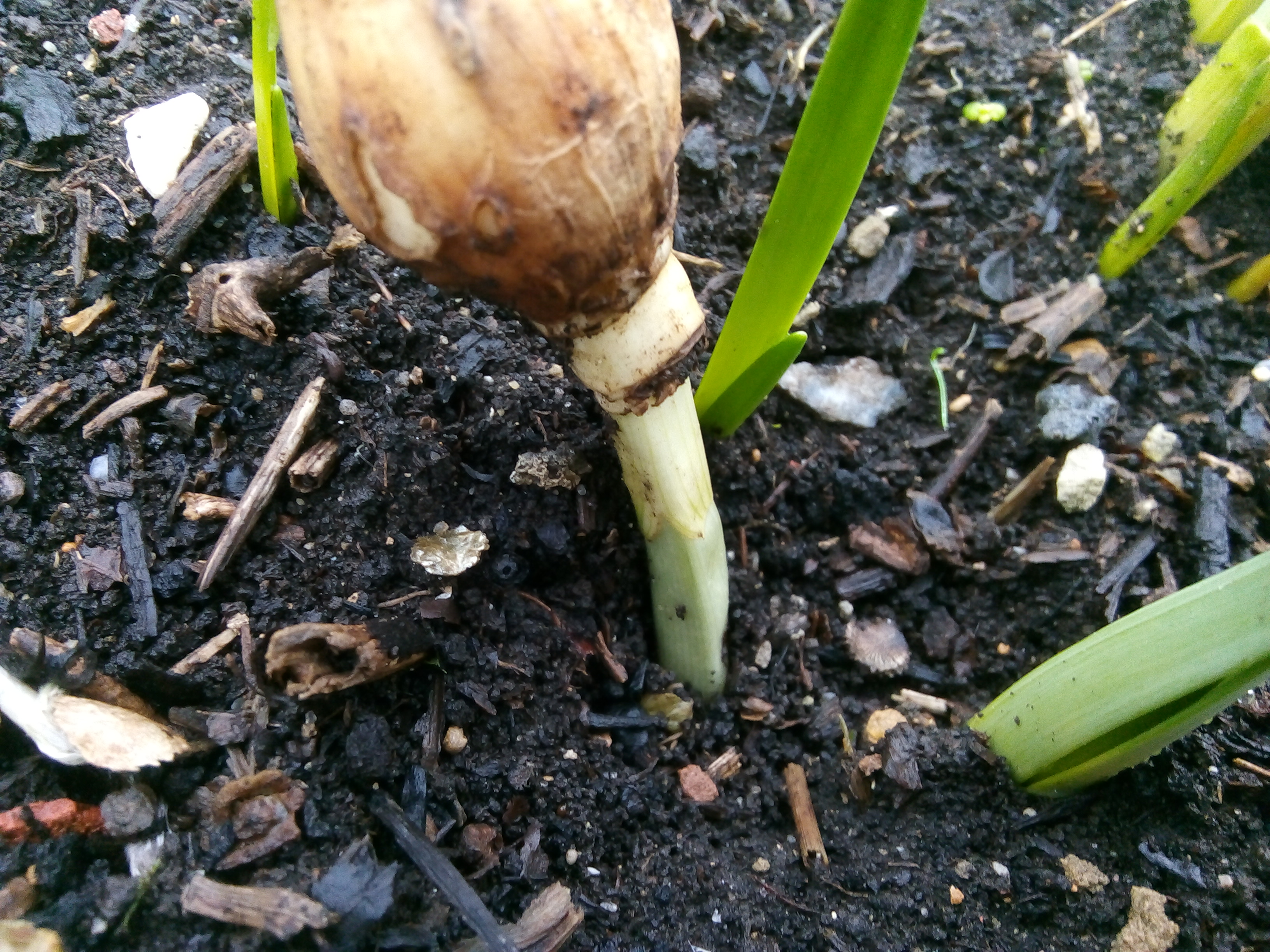
I wrote about this one a while back: it's a Daffodil bulb which was dug up by varmints, small rodents in the garden, and left on the surface of the pot. When it started to shoot, the shoot pushed into the soil - which is what it would expect to find, after all - but instead of growing upwards and into daylight, it grew downwards, and actually lifted its bulb off the ground!

I took pity on it, and reburied it the right way up, but it does go to show that - as was famously said in Jurassic Park, life will find a way: although that was a bit more sinister than one upside-down daffodil.

Where were we? Oh yes, tubers: no basal plate, no tunic (the thin skins of new potatoes don't count, before you ask!), no internal structure to speak of. They don't make offsets, or produce baby tubers: they either just get bigger every year - that would be things like Dahlias - or the tuber is used up to produce the new plant, which then produces a whole bunch of new tubers ready for the following year. If you've ever grown potatoes, you will have seen this in action:  the original "seed" potato can often be found as a shrivelled, shrunken-head sort of thing, when you lift the plants, which has meanwhile produced a whole big cluster of beautiful firm new tubers, which we then gleefully eat.

4)  and now we have Rhizomes.

These are stems which grow sideways, rather than growing upwards, so they run along under, or on, the surface of the soil. They get bigger and fatter each year, and they often branch and divide, with any one rhizome producing two new ones each year, which means they spread rapidly and exponentially.

Again, this can lead to overcrowding and reduced flowering, so every few years they can be lifted and split, as each section of rhizome will then grow into a new plant.

Here - left - are a handful of Bearded Iris rhizomes being split and re-planted, and you can see the mass of fibrous roots produced all the way along the rhizome.

You can also see how the main rhizome is producing a handful of new rhizomes at the leafy end, each of which will produce a flower the following year.

So there you have it:

Bulbs = modified leaves in layers: tunic, yes; basal plate, yes. Examples: daffodils, tulips, hyacinths, and snowdrops

Corms = swollen stem base, undifferentiated: tunic, yes; basal plate yes. Examples: crocosmia, gladiolus, freesia, and crocus

Tuber = modified stem, undifferentiated: tunic, no; basal plate, no. Examples: potato, dahlias, hemerocallis (Day Lily)

Rhizome = modified stem, undifferentiated, growing sideways: tunic, no; basal plate, no. Examples: Iris, lily-of-the-valley, canna, and ginger.


Did you enjoy this article? Did you find it useful? Would you like me to answer your own, personal, gardening question? Become a Patron - just click here - and support me! Or use the Donate button for a one-off donation. If just 10% of my visitors gave me a pound a month, I'd be able to spend a lot more time answering all the questions!!

Thursday, 28 April 2022

Pachyphragma - a much under-used plant

Don't you love it when people ask you what your favourite plant is? 

I mean, it's such a “piece of string” question: do they mean my favourite tree, shrub, perennial, bulb? My favourite flower, or foliage? Favourite in winter, or summer - or spring, or autumn? So many answers, so many to choose from. 

 But at this exact time of year, now that the Eranthis hyemalis are going over, my current favourite has to be Pachyphragma macrophyllum, whose clear, strong white flowers are now shining out at ground level. 


It's a really under-used plant, and I don't really know why: it's a bit hard to get it established, and it is quite slow growing, but once it settles down in your garden, it will spread into dense colonies, making quite effective ground cover. 

I say that, because it's not a classic ground-cover such as Ajuga reptans (Bugle), whose leaves lay flat to the ground: instead, it grows as individual plants, but the leaves are long-stemmed and lay flat all the way round each plant, overlapping and giving good ground coverage.

And right now, in spring, those mounds of foliage produce a short spike of white four-petalled flowers: each of which is tiny, but en masse they have a lovely effect.

They'll be flowering for at least a month now, and for the rest of the year, you have a rosette of rounded, ruffled-looking leaves at ground level, and being what is called semi-evergreen, it will hold those leaves through a mild winter with no trouble at all.

Best of all, it is perfectly happy in semi-shade, so it's perfect for a woodland bed, or for planting under deciduous trees or large-ish deciduous shrubs, where it gets the low spring sun: ah, remember the sun? One day it will return, one day..


Did you enjoy this article? Did you find it useful? Would you like me to answer your own, personal, gardening question? Become a Patron - just click here - and support me! Or use the Donate button for a one-off donation. If just 10% of my visitors gave me a pound a month, I'd be able to spend a lot more time answering all the questions!!

Monday, 25 April 2022

Crocosmia: have you ever wondered....

... what would happen if you were to separate that long string of corms?

Ok, backtrack: Crocosmia (formerly and sometimes still known as Montbretia) are a popular garden plant: they have long, upright, narrow leaves, topped with an arching spire of flowers.


They come in shades of yellow and orange, and are usually about knee height: and then there is the cultivar Lucifer - left - which is bright red, and waist height.

It's very popular, and deservedly so: the flowers are magnificent, the plants are super-easy to grow, they are as tough as old boots, they survive in horrible soil, they seem to thrive on neglect, and all you have to do is cut down the foliage in winter, once it's gone brown and droops sadly: then the following spring, up they come again, and by mid-summer they are blooming their socks off.

Left to their own devices, they will spread to form large clumps, which sometimes gives them a bit of a reputation for being a thug, but I don't go along with that: if you don't want them, they are very easy to remove, as they are not deep-rooted.

Because they come up smiling ever year, they are a perennial: and they are usually described as a  bulbous perennial, although technically, they grow from a Corm, not a Bulb (what's the difference? I could tell you, but it's not really important) (oh all right, I'll cover it in detail, next time!)

If you've ever dug them up, you'll know that these corms form a chain underneath the plant:

...you can see that there is a succession of flattened corms here, stacked on top of each other, with the current year's flowering shoot (now dead) just visible at the top.

Every student, every Trainee I have ever had, plus a whole lot of people who ask me questions here, have asked at some point, "Is it possible to split up these chains of corms? Will we get lots more plants, if we do?"

As you will have gathered by now, if you are a regular reader, I love to do experiments, and I hate to take other people's word for things: especially if the "other people" in question are the internet.

Pardon the grammar of that sentence!

Anyway, so there's the question - what would happen if we were to separate the chain of corms, and plant them all out individually?

Last July, my Trainee and I were lifting, splitting and moving huge clumps of Lucifer, so we decided to try an experiment for ourselves. 


 We started with a healthy-looking string or chain of corms.

The oldest is on the left, the youngest one is on the right.

As we did this in summer, right in the middle of their flowering season, we had no idea if this would work, as an experiment, or not: it probably would have been better to do it either in autumn, as everything was dying down: or, possibly, better, in early spring, to give them all a good start.

However, it was July, and we had the time, so we took this section of corms, which didn't have any greenery growing from it, and decided to give it a go.


Next, we carefully split up the chain.


Again, oldest on the left, youngest on the right, and this gave us six corms, of very different sizes.

Presumably the bigger ones were formed during "good" years?

We deliberately didn't cut the chain, we snapped them - gently, carefully - because corms have a basal plate, and if we were to damage it by cutting into it, well, it would spoil our experiment.


Now we potted each corm up separately, and in this photo we started with the oldest one in the top left, then going from left to right, then to the bottom row, left to right. 

So the youngest corm - the whitest one - is on the bottom row, far right, with a white label.

We then filled the pots with compost, watered well, and stood them to one side, to see what would happen.

For a long time, nothing happened....

Then, in December, I noticed that two of the corms had put out foliage! This was very surprising, not least because we planted them in July, at the point where they "should" have been in full flower. 

Normally, plants with underground storage organs like these, rely on what happened the previous year to be the fuel for any flowers appearing this year.

So I would not have expected those corms to do anything at all.

As  you might be able to see, only two of them made an effort: corms 2 and 3, with 1 being the oldest, and 6 being the youngest.

So 2 and 3 sent up leaves, and in due course, they died off and I removed them.

Over the winter, I kept the pots outdoors, exposed to all the usual weather, and I watered them maybe a couple of times, just to keep the compost damp.

This photo - left - was taken yesterday (we are now in late April) and you can see that all six of them are sprouting.

Which is quite exciting, and rather interesting: when left in the ground, only the top one shoots, and I know this because of the number of times I have uplifted and moved them - never once have I seen any greenery sprouting from any corm other than the top, youngest one.

So there is your answer: if you split up the chains, you will get a lot of plants.

But!

And it's a big but.... internet research suggests that only the newest one will flower. None of the others will flower, because each corm is "used up" in producing the flower, and the new corm, for the following year.

 Shame!!

Mind you, bearing in mind what I said at the beginning of this article, I am going to let these six plants grow on, and just see how many of them produce any sort of flowers.

I will let  you know.......


Did you enjoy this article? Did you find it useful? Would you like me to answer your own, personal, gardening question? Become a Patron - just click here - and support me! Or use the Donate button for a one-off donation. If just 10% of my visitors gave me a pound a month, I'd be able to spend a lot more time answering all the questions!!

Tuesday, 22 February 2022

Using wood chip as a mulch

Early last year, I started working with an Arborist, and we offer our tree Clients the option of keeping the woodchip which we produce, to be used as a mulch in their garden.

Here is an example, left: woodchips spread at the base of espaliered fruit trees, allowing the gardener to prune and attend to the trees, without having to step on earth, but without the expense of installing hard landscaping such as paving.

We like to do this, because it is about the most ecologically-sound thing you can do - for many reasons!

Firstly, it's the product of your own garden, so you are keeping the nutrients within the garden, instead of extracting them and, in effect, throwing them away. This is an extension of composting, where we strive to reclaim all the nutrients and minerals, rather than paying the bin men to take them away, or having to waste petrol going to the tip with bags of garden waste, or - worst of all - burning them.

Secondly, birds love mulch! It is quickly colonised by a myriad of bugs, beetles and other critters beginning with 'B', and the birds have a lovely time, flicking it about and scoffing to their hearts' content.

Thirdly, it means we don't have to charge our Client for taking it away - which reduces the cost of the job. 

Fourthly, it's free! Why buy expensive bags of chipped bark, or other mulch, when you can re-cycle your own trees and hedges?  Plus, if  you buy-in bags of chipped mulch, you never know quite what you are going to get, whereas when it comes from your own trees and hedges... well, you know exactly what's in it!

Some people, though, are reluctant to put chippings on their beds, for various reasons, so let's run through a few of those.

Before we get into the science of it, let's be clear about the terminology here: woodchip is applied as a mulch, which means that it sits on the surface of the soil. It is not "dug in", the way that compost, manure, 'organic matter' (posh word for manure) or soil conditioner are. 

So, what are the main concerns, then? 

Nitrogen stealing:

This is to do with the theory that wood chippings will take nitrogen from the soil, during the act of decomposition.

Not the case: as the mulch sits on top of the soil surface, and is not dug in, there is only a very small amount of nitrogen extraction being carried out by the chippings, and that all occurs on the interface between the underside of the mulch layer, and the surface of the soil. This means that any small transfer of nitrogen from the soil only affects the surface, and has no impact at all on the soil below, which is where the roots of the plants are living.

This, by the way, is possibly one reason why a thick layer of mulch suppresses weeds: although personally I think it is more to do with it being a physical barrier to prevent weed seeds making contact with the soil and by excluding light from the seeds already lying on the surface, before the mulch was applied.

Pathogens:

If the tree has any "germs" in it, will they not be transferred to the plants around which the mulch is spread? Often, the Arborists are called in because a tree is damaged, or diseased, or dying: not just to make it a bit smaller, neater, or tidier. It's a fair point, but again, chippings are used on the surface of the soil, not underground where the roots are.

Allelopathy:

This is a variation on the theme of Pathogens: there are some trees which contain chemicals, which  suppress the growth of competing plants. Walnut is allegedly one (although I have never yet found a Walnut tree with nothing growing underneath it), Rhododendrons is another, as is Cherry Laurel. So would wood chip (Digression: "how much wood, would a wood-chipper chip, if a wood-chipper would chip wood?" Answer: we can fill a one-ton builder bag in about ten minutes of intensive chipping!) therefore not kill everything, where you spread it? The answer is basically "No", because mulch sits on top of the soil, it is not dug in: meaning that any allelopathic chemicals do not get incorporated into the soil, where the roots of the plants are.

Cleanliness: next to godliness, so they say.

Chippings are bulkier than bought mulch: the chips form a matrix which creates a whole ecosystem for bugs, worms, and even small mammals to live, work, eat, and die in. Importantly, this matrix also allows air and water down into the soil, and the larger size of the chips means that soil and "dirt" gets washed down between the chips every time it rains, so the surface stays clean and mud-free. This makes it easier to walk across the area without getting muddy feet, which is nice for the gardener, and nice for the lawn as well!

Smothering the plants:

You often read the phrase "apply mulch in a deep layer, 4-6" deep."  I have never yet, not once, seen mulch spread that deeply. Good heavens, it would make the beds look ridiculous, if you piled 6" of mulch on top of the bed!  I would say that 2" is a more reasonable depth to aim for: enough that you can't see the soil through the mulch, if you casually stir it with your foot.

And personally, when applying mulch on "my" gardens, I always spread or rake it out by hand, and I tend to draw it back from the stems of shrubs. Herbaceous perennials generally find their own way up through a layer of mulch, but I would never put mulch over Peonies (because they don't like their tuber to be buried, it adversely affects the flowering) and Bearded Iris, because their rhizomes need to sit on the surface, and be baked by the sun each summer, in order to promote good flowering the following year.  

Bulbs, of course, will push their way up through any amount of mulch, even through this pile of bricks - right.

And I am very fussy about not piling wood chippings, or any sort of mulch, for that matter, up around the trunks of trees. I will always draw the mulch away from close contact with the bark of a tree.

That deals with the usual objections: there are also a couple of really good, positive reasons for using wood chippings as a mulch.

Soil surface preservation:

A thick mulch of chippings slows down the effect of rain on the soil: during heavy rain, instead of the soil being battered and waterlogged, the mulch absorbs and slows down the passage of the rain, allowing it time to be absorbed gently into the soil below. This prevents the creation of a surface pan, or "capping" where excess water dries and creates a crust: it also prevents soil erosion and the washing out of nutrients.

Temperature regulation:

A thick mulch of chippings protects the soil - and therefore the roots of the plants - from extremes of temperatures. In summer, it takes the worst of the baking heat - ah, remember baking heat? Did we have any, last summer? I can barely remember being hot... *sigh* - which keeps the soil below cooler: and in winter, it obviously provides a snug anti-frost covering.

Long lasting:

Chippings last a lot longer than bags of bought mulch, which quickly "composts" down and disappears into the soil. Sometimes this is what you want, but sometimes you want a mulch to remain on duty for longer, and chippings are ideal for that.

Where to use them:

On beds and borders: in a fairly thin layer. Don't worry about bulbs, they will push right up through the mulch with no problem.

Under hedges: as thickly as you like, which will help to cut down on weeds, and will provide a lovely ecosystem of bugs to feed birds and small mammals.

Under and around trees, for a natural woodland look

As a top surface for paths: wood chip makes a good all-weather surface which isn't dusty in summer, and doesn't make your shoes muddy in winter.

To absorb moisture from areas which have been trampled and worn out: just spread it around on the muddy areas, and keep topping it up until it's no longer muddy!

So there you go, many good reasons to use wood chippings as a mulch on your garden!


Did you enjoy this article? Did you find it useful? Would you like me to answer your own, personal, gardening question? Become a Patron - just click here - and support me! Or use the Donate button for a one-off donation. If just 10% of my visitors gave me a pound a month, I'd be able to spend a lot more time answering all the questions!!

Thursday, 16 September 2021

What is the difference between compost, organic matter, and leaf mold?

This is a question from a recent Training Day Student: they asked me to clarify the differences between compost, multi-purpose compost, leaf mold, farmyard manure, potting compost, John Innes, organic matter, etc  - what were they, what was the difference between them, and did we use them for different things?

This is an excellent question!

It's one of those things that every professional gardener knows, as a matter of course, and it's easy to forget that we were all new to it, once. 

So here we go! What do we have, under the general heading of "compost"?

1) Compost - home-made

2) Compost - multi-purpose

3) Farmyard manure

4) Organic matter

5) Manure from someone's muck heap

6) John Innes products

7) Leaf mold

Let's look at each of those in turn - grab yourselves a cup of tea, folks, this might be a long post!

1) Compost - home-made. This is what we make in our own gardens,  from our own weeds, cut-down herbaceous material, kitchen vegetable scraps and so on, which rot down into "compost". It is free to make, and it is fantastically "eco", because we are keeping all the nutrients within our own garden, which is a good thing for many, many reasons. It teaches us about the true meaning of recycling, it reminds us of the circular nature of gardening, and it teaches us patience - it takes as long as it takes, and there is no point trying to rush it.

Use for: potting on cuttings, digging into beds and borders, using as a mulch.

Pros: free to make, on hand when we need it (because it's already in our gardens!), rich with nutrients.

Cons: takes time, is messy - and compost pens are rarely pretty, plus they take up space in our gardens.

2) Compost - multi-purpose. This is the stuff we buy in plastic bags from the garden centres. It used to be made mostly from peat, mixed with rotted plant material,  but now we know that Using Peat Is Bad, so it's mostly plant-based by-products such as coir, bark, coconut husks, and so on with - allegedly - added fertiliser.  It's mass-produced, it often contains contaminants such as glass, stones, plastic etc, which vexes me, and I have written about this at length. The worst thing about shop-bought compost is that if you let it dry out, it is very difficult to re-wet it: you have to tip it into a tray, add water, and physically push the water into the dusty compost, using the same action as when you "rub up a crumble". And if you don't know what that means, I've described it in detail, here

Use for: seedlings, potting on cuttings, potted plants. 

Pros: cheap to buy, easy to transport (it comes in bags), fairly clean to use.

Cons: goes dusty if allowed to dry out, only contains enough nutrients for 6 weeks (read the pack! It says so!), is often contaminated, is of variable quality, and uses a lot of carbon with packing, transporting, storage etc.

3) Farmyard manure. This is now available in bags, to buy, from garden centres, which used to make me laugh like a drain when I first saw it. Yes! People are buying small bags of cow poo! *laughs* Anyone who has ever walked past a farm will know what a huge volume of cow poo is produced in the UK, great steaming heaps of it, so it strikes me as amusing that townies are buying it in dainty little 50litre bags.  However, if your garden soil is lacking in nutrients, or in "body", then adding farmyard manure is the best thing you can do, and at least by buying it, you are supporting the farming industry.

Use for:  digging into beds and borders, using as a mulch.

Pros: neatly packaged, clean to transport, good rich stuff. Properly speaking, it should be regulated, so it should contain known amounts of nutrients, and should not contain more than an acceptable level of chemicals, drugs, etc (ie all the treatments given to the cows, in their normal farmed lives).

Cons: again, packaging, transporting: all of which is a high carbon cost.

4) Organic matter: this is the posh name for farmyard manure. For squeamish townies who don't like the idea of putting cow poo on their gardens. Poor souls.

5) Manure from someone's muck heap. Anyone with a horse or two will gladly give the stuff away for free, because horses, like cows, are basically poo-machines: you put grass (hay/feed etc) in one end, and get poo out of the other. The trick is to get what is known as "well-rotted manure". Fresh horse poo is too "hot" to use on plants: it generates heat as it rots, and literally burns the plants. But very old horse poo, which has been badly stored, or has become water logged, is horrible stinky stuff, and will not doe your roses much good. "Well rotted" manure is a homogenous mass, which does not smell of anything in particular, and is not unpleasant to the touch. If you can see individual "clods" of poo, then it is not well rotted. If it stinks, it is not well rotted. If it is slimy and heavy, it is not well rotted. If someone invites you to help yourself to their muck heap, ask them which is the oldest one, and head there.

Use for:  digging into beds and borders, using as a mulch. 

Pros: free! Should be lovely rich stuff, full of nutrients.

Cons: you normally have to shovel and bag it up yourself, so it's hard work, and can make a mess of your car.  Also, it may well contain drugs/chemicals from anything given to the horses, ie worming treatments, other medication etc. Another good reason for heading for the oldest part of the muck heap, in the hopes that any chemicals will have degraded.

6) John Innes products: ah, the holy grail of gardeners. Loam based products, finely graded and tested for nutrient value, and selected for various uses, ie seed compost, potting compost etc. Loam, by the way, is the Ultimate Soil. It's friable, holds water well, full of nutrients and minerals, is lovely to handle, etc etc etc. 

Use for: seedlings, potting on cuttings, plants in pots: there is a different grade for most requirements.

Pros: all of the above.

Cons: expensive!

7) Leaf mold. A bit of a soap-box of mine... I am always writing about it, I've even written an eBook about it!  (How to Make Compost and Leaf Mold - does what it says on the cover...) Briefly, you just rake up all your fallen tree leaves in autumn, and let them rot themselves down into a wonderful lightweight, fluffy, non-smelly product which you cannot buy... no, no-one sells it, I can't think why, and as soon as I move house and get a bigger garden, I am going into production, believe me! Leaf mold does not contain much in the way of nutrients, but has a lot of minerals, and is a truly fantastic soil conditioner. 

Use for: seedlings and potting on cuttings, if mixed 50/50 with compost:  digging into beds and borders, using as a mulch. 

Pros: free! Easy to make! Takes an annoying waste product - dead leaves - and turns it into something wonderful!

Cons: takes time - 2 years minimum. But patience is a virtue....

So there you go, a quick run-down of the main types of "compost", their differences and their uses. 

And to make it even easier for you, here's a handy table!


D


Did you enjoy this article? Did you find it useful? Would you like me to answer your own, personal, gardening question? Become a Patron - just click here - and support me! Or use the Donate button for a one-off donation. If just 10% of my visitors gave me a pound a month, I'd be able to spend a lot more time answering all the questions!!

Saturday, 4 September 2021

How to get rid of Ash saplings when digging is not an option

This is very much going to be Part I of the saga...

There are certain trees which pop up in all our gardens.... Ash, Sycamore, Hawthorn, Hazel, and Norway Maple, for a start. Almost everywhere.

Slightly less widespread - or, should I say, more localised - would include Walnut, Lime, Laburnum, and Oak. If your garden, or that of your neighbours, has one of those trees, then you are probably weeding them out all the time. Oh, and I should add Yew to that list: a good Yew hedge in one garden will generate cute little Yew seedlings for a fair distance to either side.

I'm sure that, wherever you are in the country, you could add a couple of trees to that list. 

Now, trees are wonderful things, but we don't usually want them in the garden

Normally, as a professional gardener, I spot them early, and weed them out while they are tiny.

This delicate, pretty little thing - left - would, if left unweeded, turn into a Lime tree.

Honest!

And that's all part and parcel of being a professional: it's being able to spot the weeds among the "proper" plants, being able to recognise them at their early stages of development.

Something this tiny is easy peasy to weed: just take hold and pull gently, and out it comes.

And if you pull not-very-gently, and it snaps off, well, you're pretty much guaranteed to have killed it, so that's not a problem any more.

Ash seedlings are easy enough to recognise, as they exhibit the classic compound leaves very early on, when they are still small enough to pull out, easily and quickly. Once you have seen a few hundred of them, you learn to spot them before they have even produced the first set of "proper" leaves:

Here's a handful I pulled out, recently - it does make you wonder why the UK inadvertently set in motion the wholesale slaughter of our Ash trees, by importing disease-ridden ones from Europe... when they grow so easily, and are weeded out in such huge quantities....

*sigh*

But enough of that, back to the plot: if you miss an Ash seedling, it quickly grows into an Ash sapling, and that's a lot harder to deal with, as they produce an initial long, strong taproot, which is, as we gardeners say, "a bugger" to dig out.

There is a whole sub-set of lazy gardeners out there, who don't bother to dig out the saplings, and instead they just cut them off at ground level, or as close as they can, and hope that no-one will notice. Alas, Ash will regrow from this treatment, as will Sycamore, Hazel, and Hawthorn, and probably most of the others, as well.  Instead of having a sapling, you then find, a year or two later, a thicket of the stuff, springing multi-stemmed from the cut-off stub.

Then there's the situation where the invader cunningly positions itself right by something with very similar leaves, so that it goes un-noticed.

This is what happened in the garden of a friend of mine: she has a lovely Wisteria, growing up some battered old trellis, and when I was there last week, I spotted the Ash tree which was taller than I was, by a fair amount. It had sneakily grown right up high, inside the cover of the similarly-leaved Wisteria.

It was far too big to dig out, not to mention that it was hemmed in on one side by a patio, and on the other by the base of the trellis fencing, so all I could do was cut it off as low down as I could, just like one of those not-very-good gardeners which I mentioned above. 

My first suggestion was to wait until it had sprouted a few new leaves - which, of course, it will - and then spritz them with weedkiller: nice fresh, young, leaves are very good at absorbing the chemicals, so it should be successful.

But, alas, my friend does not allow the use of weedkillers in her garden (which explains the amount of bindweed, cinquefoil etc, but who am I to criticise?) (*laughs*), so I had to come up with another plan.

As you can see from this photo, I took a leaf out of the arborists' book, if you'll pardon the expression, and sawed a few vertical cuts in the stump, in the hopes that water would get inside the stump, and rot it.

I will keep an eye on it, over the next few months, and we'll see what happens!

Any bets, anyone?!


Did you enjoy this article? Did you find it useful? Would you like me to answer your own, personal, gardening question? Become a Patron - just click here - and support me! Or use the Donate button for a one-off donation. If just 10% of my visitors gave me a pound a month, I'd be able to spend a lot more time answering all the questions!!

Monday, 16 August 2021

Roses! Roses with fasciation!

Yet more fasciation - what is happening to the world?! *laughs*

I've spent the last several years waiting, with bated breath, to find the rare examples of fasciation, and now they are popping up left, right and centre!

This week, it's the Roses...

I've written about Fasciation several times - just type the word into the Search box at the top left of the page - so I won't cover it in detail again, other than to say that it is a spontaneous, harmless, mutation which plants sometime exhibit.

This is a rose stem, left: and  I have never before seen fasciation on roses, so this was quite exciting for me!

As you can see, left, the stem is madly curved - it's not floppy, it's perfectly rigid, but instead of being straight, it has this crazy curve.
 

Fasciation usually manifests like this - the stems become flattened and ribbed, instead of being round, and they often adopt strange curves, instead of being straight.

It's not infectious, it doesn't adversely affect the plant, it's not "permanent" in the sense that a particular plant might show some fasciation this year, and might never do it again.

It just looks a bit odd, doesn't it?!


Did you enjoy this article? Did you find it useful? Would you like me to answer your own, personal, gardening question? Become a Patron - just click here - and support me! Or use the Donate button for a one-off donation. If just 10% of my visitors gave me a pound a month, I'd be able to spend a lot more time answering all the questions!!

Tuesday, 13 July 2021

Fasciation again: now it's on Wisteria!

Well, folks, you might be tired of hearing about fasciation: but I find it quite fascinating (ha! ha! See what I did there?) and I'm always astounded when I find a new example of this harmless, but rather scary-looking, mutation.

Here's the latest one: Wisteria.

Yes, that well-known and well-loved climber, the one which drapes our houses and arches with long dangling plumes of usually purple (sometimes white) flowers in late spring... yes, it also suffers from this weird distortion.

Here's a fasciated stem which I found last week: you can see the typical longitudinal lines running up the stem.

Weird, huh?


And here's the same stem, rotated onto its side, to show you how flattened it is.

As you probably know, Wisteria stems ought to be round! 

Plump and round.

Not looking as though they've been ironed.

This means we can add Wisteria to the list of plants which exhibit this curious, but harmless, spontaneous mutation: the list now includes Buddleia, in Forsythia, Summer Jasmine and Hibiscus: in Asparagus (that one surprised me!), in Roses, and even in Bindweed

So there are plenty of articles to read, if you find this subject as interesting as I do!


Did you enjoy this article? Did you find it useful? Would you like me to answer your own, personal, gardening question? Become a Patron - just click here - and support me! Or use the Donate button for a one-off donation. If just 10% of my visitors gave me a pound a month, I'd be able to spend a lot more time answering all the questions!!